A zombie is an undead corpse, originating from certain pre-War religious beliefs and popularized by fiction films and entertainment. While it is sometimes used as a derogatory term for zealous cultists perceived to have no free will of their own, it is most often used by bigoted wastelanders as a deeply offensive racial slur referring to Ghouls. The corpse-like appearance of Ghouls, the slow shuffle with which the more decrepit move and the ignorance or unwillingness of some to differentiate between feral and intelligent Ghouls, have led to such slurs as brain eater and zombie. This also popularized the belief that Ghouls can only be killed by shooting them in the head. Ghouls in turn often refer to normal humans as smoothskins, while Super Mutants often use the term bleeders. Many posthumans, such as Ghouls and Super Mutants, suffer from inequal treatment by normal humans, ranging from name calling, racial segregation to outright hostility, in the most extreme cases even leading to lynchings or slavery. As of yet very few places in New California have managed to create a truly open, harmonious society where all races are accepted and considered equal. Racial discrimination is outlawed in the NCR, though as always societal viewpoints are slower to evolve than legislative ones. Nevertheless the ranks of the NCR military and Rangers are among the most diverse to be found and the status of posthumans is changing for the better.

Showing posts with label A-Z. Show all posts
Showing posts with label A-Z. Show all posts
Saturday, April 30, 2011


Friday, April 29, 2011
A-Z Fallout lore
Y is for Yuma Flats Energy Consortium
Yuma Flats is a household name for scavengers, sure to bring dollar signs to their eyes. Specializing in high-energy weapons research, the Yuma Flats Energy Consortium produced some of the most powerful pulse weapons available before the War. Though branded as pulse weapons, the YK models of Yuma Flats are not actually electromagnetic pulse weapons, but rather fire electrical pulses, especially effective at burning through heavy armor and disintegrating biological matter. It is assumed that true EMP weapons for use against electronic targets never saw successful mass production, or all existing copies were lost after the War. The Consortium's initial designs led to the development of a lightweight electrical pulse pistol, the YK32. Due to its bulk and inordinate energy usage the pulse pistol never became popular and was quickly phased out by the YK42B pulse rifle, allowing for greater range and energy capacity. These highly advanced rifles were rare even before the War, distributed only to select army units, and are understandbly seldom found in the wasteland, making a functional Yuma Flats gun a very lucrative find.
Thursday, April 28, 2011
A-Z Fallout lore
X is for Xander root
Xander root is a bulbous, tuberous root, used predominantly in tribal medicine for its mild healing properties. The root is only found growing in the wild, usually around rocky outcrops or near withered vegetation and can be identified by skilled outdoorsmen by its exposed head and tall green leaves, jutting out from a small earthen mound. By itself the ingestion of the bland tasting but nutritious root has only a negligible restorative effect on one's constitution. Tribal medicine men and women however make use of the root in combination with ground up Broc flower to make a much more potent, though slightly narcotic, healing powder. The ascribed healing properties of Xander root have been ascertained by medical science as well. In the absence of proper synthesized chemicals, the root is sometimes used as an ingredient in stimpak production, though the scarcity of the root and failure to cultivate it makes this process impractical on a larger scale.
Xander root is a bulbous, tuberous root, used predominantly in tribal medicine for its mild healing properties. The root is only found growing in the wild, usually around rocky outcrops or near withered vegetation and can be identified by skilled outdoorsmen by its exposed head and tall green leaves, jutting out from a small earthen mound. By itself the ingestion of the bland tasting but nutritious root has only a negligible restorative effect on one's constitution. Tribal medicine men and women however make use of the root in combination with ground up Broc flower to make a much more potent, though slightly narcotic, healing powder. The ascribed healing properties of Xander root have been ascertained by medical science as well. In the absence of proper synthesized chemicals, the root is sometimes used as an ingredient in stimpak production, though the scarcity of the root and failure to cultivate it makes this process impractical on a larger scale.
Wednesday, April 27, 2011
A-Z Fallout lore
W is for the Water Merchants
The Water Merchants are one of the largest and wealthiest caravan companies in the NCR, specializing in transporting water across the wasteland. The Water Merchants and their closest competitors, the Far Go Traders and the Crimson Caravan, together are known as the Big Three, all originating from and keeping their headquarters in the Hub. The Merchants rose to prominence in the early 22nd century during the turmoil that followed after Angus, the founder and governor of the town, was murdered. The Merchants seized control of the oasis’ water tower and started demanding tolls of rival companies for access to the water supply. This led to the conflict known by the Hubbers as the Great Merchant Wars. The Merchants sealed up the town but were outnumbered, and a standoff ensued. The situation lasted for two years until a settlement was negotatiated, leading to the creation of the Hub’s central council, consisting of two representatives of each caravan company and chaired by a law officer, now the NCR governor. The council succeeded in restoring the peace in the Hub and eventually the existing status quo between the caravan groups was grudgingly accepted. It was through backing from the council that bottle caps later came to be accepted as the regional currency, which led to bottle caps also being refered to as „Hub bucks“ in their heyday. Now as part of the NCR, the Hub’s merchant groups have managed to further increase their influence, using their economic weight to gain a foothold in top political circles as well. The scarcity of fresh water sources in many areas of the wasteland ensure the Water Merchants’ continued prosperity, and caravans set out on a daily basis from the Merchants' district in the Hub, dominated by the water tower, to other towns in the region.
Tuesday, April 26, 2011
A-Z Fallout lore
V is for the Vault Dweller
The Vault Dweller, or the Stranger, is a semi-legendary figure, featured in tales from the time of the foundation of the New California Republic
“To the Stranger and Vault 13: What doesn't exist, we must sometimes dream and let our dreams inspire us to greater heights. So it was with the Stranger and his belief in the legend of Vault 13.”
Monday, April 25, 2011
A-Z Fallout lore
U is for Uranium
Uranium is a radioactive element, which in its enriched form is used as the basis of most types of nuclear weapons and as fuel for nuclear power plants. As the world's fossile fuel reserves had almost completely been exhausted in the second half of the 21st century, the realization of economically viable nuclear fusion presented a promising solution to the energy crisis, which the underdeveloped renewable energy industry had failed to do. New power plants were erected, existing ones modified, and even the first weapons and vehicles were produced, taking advantage of sophisticated miniaturized fusion technology. In retrospect, with more time nuclear fusion could probably have averted what ensued; as it was in 2077 the world was still too dependent on oil. The switch to fusion energy only partially completed, and only in the most developed regions, global devastation and nuclear winter followed as the Great War settled the conflict over the last remaining oil reserves. Now more than ever, energy is an extremely valuable commodity, together with fresh water supplies deciding the fate of the various settlements in the wasteland that slowly rose from the ashes. Though the theoretical knowledge of nuclear fusion has been lost, some power plants, generators and equipment survived more or less intact and are now the wasteland's main source of energy. This has in turn created a new dependence, no longer on oil, but on the rare uranium ore. Many prospectors spend their days surveying the wastes in vain, hoping to strike one of the fabled "mother lodes" on their mining claims. Thus far there is only one known source of uranium, and its continuous flow is of vital importance to the major powers in the region. From the mining town of Broken Hills regular caravans leave for Vault City, Gecko and the NCR, trading uranium for medical supplies, cattle or money. The mining operation is often cited by proponents as an example of how the harmonious coexistence of humans and post-humans can benefit all those involved. The uranium ore is mined by teams of Super Mutants, who seem impervious to the harmful radiation. The town's refinery is operated by Ghouls, benefiting from the stores of technical know-how accumulated in their extended life spans. The business side and organization of caravans is handled by the regular humans. The uranium trade is so crucial that even those inimical to mutants see themselves forced to deal with Broken Hills. However, the risk of disrupting the uranium flow and Broken Hills' isolated location act as a strong deterrent to those who would consider taking over the town by force.
Uranium is a radioactive element, which in its enriched form is used as the basis of most types of nuclear weapons and as fuel for nuclear power plants. As the world's fossile fuel reserves had almost completely been exhausted in the second half of the 21st century, the realization of economically viable nuclear fusion presented a promising solution to the energy crisis, which the underdeveloped renewable energy industry had failed to do. New power plants were erected, existing ones modified, and even the first weapons and vehicles were produced, taking advantage of sophisticated miniaturized fusion technology. In retrospect, with more time nuclear fusion could probably have averted what ensued; as it was in 2077 the world was still too dependent on oil. The switch to fusion energy only partially completed, and only in the most developed regions, global devastation and nuclear winter followed as the Great War settled the conflict over the last remaining oil reserves. Now more than ever, energy is an extremely valuable commodity, together with fresh water supplies deciding the fate of the various settlements in the wasteland that slowly rose from the ashes. Though the theoretical knowledge of nuclear fusion has been lost, some power plants, generators and equipment survived more or less intact and are now the wasteland's main source of energy. This has in turn created a new dependence, no longer on oil, but on the rare uranium ore. Many prospectors spend their days surveying the wastes in vain, hoping to strike one of the fabled "mother lodes" on their mining claims. Thus far there is only one known source of uranium, and its continuous flow is of vital importance to the major powers in the region. From the mining town of Broken Hills regular caravans leave for Vault City, Gecko and the NCR, trading uranium for medical supplies, cattle or money. The mining operation is often cited by proponents as an example of how the harmonious coexistence of humans and post-humans can benefit all those involved. The uranium ore is mined by teams of Super Mutants, who seem impervious to the harmful radiation. The town's refinery is operated by Ghouls, benefiting from the stores of technical know-how accumulated in their extended life spans. The business side and organization of caravans is handled by the regular humans. The uranium trade is so crucial that even those inimical to mutants see themselves forced to deal with Broken Hills. However, the risk of disrupting the uranium flow and Broken Hills' isolated location act as a strong deterrent to those who would consider taking over the town by force.
Saturday, April 23, 2011
A-Z Fallout lore
T is for Tandi
Tandi was the second president of the NCR, responsible for its rapid growth and prosperity, and one of the most influential political figures in the post-War wasteland. Born in 2145 in the small village of Shady Sands, daughter of the settlement's leader Aradesh, already at a young age Tandi displayed the exceptional strength of character and resolve which would serve her well in her later life as first the towns and later the entire federation's leader. Tandi's life changed forever when at the age of sixteen she met the legendary hero known as the Vault Dweller, who later rescued her from the hands of the Khan raiders after they had kidnapped the girl during a raid. Inspired by his example, Tandi went on to help her father expand Shady Sands. After the disappearance of her father in 2196, Tandi followed in his footsteps as President. Determined to bring peace and stability to the wasteland, she looked beyond the borders of Shady Sands, now the New California Republic, and opened talks and trade routes with the outside world, beginning with Junktown and The Hub. As the NCR came to dominate the Brahmin trade and the first towns began to join the federation and the first states emerged, the NCR became an economic power without equal. In the following decades more towns would follow, peace and stability came over the lawless wastes and Tandi's popularity soared, assuring her reelection to office for all her subsequent terms as President, 52 years in total, until her death at the age of 103 a year ago. Universally loved for bringing peace, prosperity and democracy to the wasteland and common man, parts of her political legacy are not without their critics. Some question the democratic health of the republic, after a 52 year uninterrupted reign by one person, growing corruption, power-brokering lobbyists, cattle barons and trade companies. The lofty ideals of her early presidency were gradually replaced by a grittier pragmatism, resulting in deals such as the New Reno alliance and giving more leeway to right wing elements in Congress. Many expect the coming years to be critical for the NCR's survival as a democratic federation. Many places and building are named in honor of Tandi, and her portrait is pictured on the new NCR $100 bills.

Tandi was the second president of the NCR, responsible for its rapid growth and prosperity, and one of the most influential political figures in the post-War wasteland. Born in 2145 in the small village of Shady Sands, daughter of the settlement's leader Aradesh, already at a young age Tandi displayed the exceptional strength of character and resolve which would serve her well in her later life as first the towns and later the entire federation's leader. Tandi's life changed forever when at the age of sixteen she met the legendary hero known as the Vault Dweller, who later rescued her from the hands of the Khan raiders after they had kidnapped the girl during a raid. Inspired by his example, Tandi went on to help her father expand Shady Sands. After the disappearance of her father in 2196, Tandi followed in his footsteps as President. Determined to bring peace and stability to the wasteland, she looked beyond the borders of Shady Sands, now the New California Republic, and opened talks and trade routes with the outside world, beginning with Junktown and The Hub. As the NCR came to dominate the Brahmin trade and the first towns began to join the federation and the first states emerged, the NCR became an economic power without equal. In the following decades more towns would follow, peace and stability came over the lawless wastes and Tandi's popularity soared, assuring her reelection to office for all her subsequent terms as President, 52 years in total, until her death at the age of 103 a year ago. Universally loved for bringing peace, prosperity and democracy to the wasteland and common man, parts of her political legacy are not without their critics. Some question the democratic health of the republic, after a 52 year uninterrupted reign by one person, growing corruption, power-brokering lobbyists, cattle barons and trade companies. The lofty ideals of her early presidency were gradually replaced by a grittier pragmatism, resulting in deals such as the New Reno alliance and giving more leeway to right wing elements in Congress. Many expect the coming years to be critical for the NCR's survival as a democratic federation. Many places and building are named in honor of Tandi, and her portrait is pictured on the new NCR $100 bills.

Friday, April 22, 2011
A-Z Fallout lore
S is for the Slaver's Guild
The Slaver's Guild is a powerful alliance of veteran slavers controlling much of the slave trade in northern California. While slavery is outlawed in the NCR and other civilized settlements, the practice persists in many other areas and is a very lucrative business in the post-War wasteland. Rather than compete against each other, several smaller groups of slavers banded together to organize joint capture hunts and fix market prices. The loose alliance grew into a strictly controlled guild which now dominates the slave trade, so much that operating without the Guild's approval is likely to get a slaver killed. Members of the Slaver's Guild must have the Guild's distinctive mark tattooed on their face, making it very easy for the Guild to spot outsiders putting slaves up for auction and take appropriate action. As most settlements in northern California lack any real government, the tightly run Guild often controls the smaller towns where it operates, openly or behind the scenes. The Slaver's Guild headquarters are located in the Den, as well as a smaller branch in New Reno, where it maintains relations with the local crime families, trading slaves for weapons and drugs. Though slavery is fiercely opposed and outlawed by the NCR, the Guild nevertheless manages to conduct limited business in its territories, exploiting several legal loopholes, much to the chagrin of abolitionists. NCR Rangers often seek out slaving expeditions beyond the Republic's borders and destroy them whenever possible, making the Rangers and slavers mortal enemies. Ironically, the Slaver's Guild can be considered one of the most inclusive organizations in the wasteland, accepting members of all races, colors and creeds.
The Slaver's Guild is a powerful alliance of veteran slavers controlling much of the slave trade in northern California. While slavery is outlawed in the NCR and other civilized settlements, the practice persists in many other areas and is a very lucrative business in the post-War wasteland. Rather than compete against each other, several smaller groups of slavers banded together to organize joint capture hunts and fix market prices. The loose alliance grew into a strictly controlled guild which now dominates the slave trade, so much that operating without the Guild's approval is likely to get a slaver killed. Members of the Slaver's Guild must have the Guild's distinctive mark tattooed on their face, making it very easy for the Guild to spot outsiders putting slaves up for auction and take appropriate action. As most settlements in northern California lack any real government, the tightly run Guild often controls the smaller towns where it operates, openly or behind the scenes. The Slaver's Guild headquarters are located in the Den, as well as a smaller branch in New Reno, where it maintains relations with the local crime families, trading slaves for weapons and drugs. Though slavery is fiercely opposed and outlawed by the NCR, the Guild nevertheless manages to conduct limited business in its territories, exploiting several legal loopholes, much to the chagrin of abolitionists. NCR Rangers often seek out slaving expeditions beyond the Republic's borders and destroy them whenever possible, making the Rangers and slavers mortal enemies. Ironically, the Slaver's Guild can be considered one of the most inclusive organizations in the wasteland, accepting members of all races, colors and creeds.
Thursday, April 21, 2011
A-Z Fallout lore
R is for RobCo
RobCo Industries was one of the largest pre-War manufacturers of consumer and military electronics, computer systems and robots in the United States. Even today the name RobCo is known to every scavenger and tech-savvy wastelander. Most of the more advanced technologies remaining in the wasteland were produced by the company or one of its subsidiaries, and virtually all computer terminals still in working order run on RobCo’s Unified Operating System. Founded in the mid-21st century, RobCo quickly became one of the most powerful corporations in the world, further increasing its dominance by numerous successful joint ventures and takeovers. Partnered with General Atomics International, RobCo cornered the consumer robotics market with the Protectron and Mr. Handy models, while distributing Securitron and Mr. Gutsy robots to the US military, as well as the Stealth Boy personal stealth devices. Later acquisitions such as REPCONN Aerospace broadened the company’s product range to include aerospace technology. But no doubt the most successful partnership RobCo forged was their collaboration with Vault-Tec, the company contracted by the US government to design and produce the enormous Vault fallout shelter project. RobCo created several of the Vault systems, among them the vault dwellers’ personal information processors, the Pip-Boy 2000 and 3000 series. As most of this electronic equipment and machinery has withstood the passage of time and century-long neglect remarkably well, forgotten or deserted Vaults and RobCo factories can thus be veritable treasure troves for entrepreneuring scavengers.

Wednesday, April 20, 2011
A-Z Fallout lore
Q is for Quartz
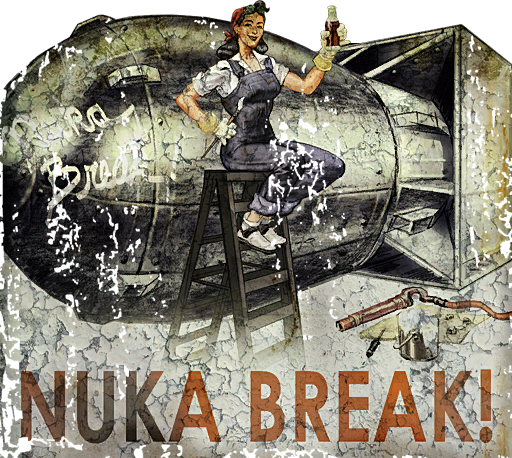
Quartz is a flavor of the pre-War United States’ most popular carbonated soft drink, Nuka-Cola, unique to the American southwest. Invented and marketed some decades before the War, the caffeinated, fruit-flavored soda quickly took the country by storm and gained an extremely dedicated, widespread following. Vending machines selling ice-cold Cola could be found on virtually every street in every American town. Thanks to its ubiquity and enormous production reserves, Nuka-Cola can still be found and enjoyed to this day in the wasteland, though the bottles’ contents are generally rather flat and warmer than ideally served. Popular as ever, well-to-do fans of the soft drink are known to pay good money to scavengers selling memorabilia of the brand or the very rare novelty editions which the Nuka-Cola Co. started producing shortly before the bombs fell. Nuka-Cola Quantum and Clear were released on the east coast market, while in the southwest the Victory and Quartz flavors were introduced. Quartz is a clear drink with no coloring in contrast to Victory, which contains a mild isotope to make it glow in the dark. Searching for abandoned Nuka-Cola plants has thus become an interesting alternative for scavengers to make a living.
Tuesday, April 19, 2011
A-Z Fallout lore
P is for Power Armor
Powered Infantry Armor was the pinnacle of pre-War military technology and is now one of the most coveted technological artifacts in the wasteland. During the Sino-American War, United States military researchers and contractors developed many new weapon systems to get the upper hand over the Chinese. While China experimented with stealth technology, the United States perfected the first prototypes of their man-based tank design for the army’s mechanized cavalry. The first suits of T-45d Power Armor were deployed in Alaska and proved to be an enormous military asset, despite the fact that the early suits burned through energy cells at an alarming rate. Allowing a single soldier to carry heavy ordinance and withstand overwhelming numbers of enemy combatants, Power Armor units were instrumental in the reclamation of Anchorage from the communist invaders. Shortly before the Great War the improved T-51b suits were manufactured, with built-in microfusion packs eliminating the energy problem of earlier models. After the War, Power Armor is rarely seen in the wasteland. Only those groups rumored to have ties to the old US military or government, such as the Brotherhood of Steel, have access to the remaining examples of this extremely valuable technology. Few suits made it into other hands, and those who examined them say that without specialized training the operation of the Power Armor’s gyroscopic systems is utterly impossible, while removing these hydraulics reduces the armor’s functionality to little more than cumbersome suits of metal armor.

Monday, April 18, 2011
A-Z Fallout lore
O is for Operation Anchorage
According to historical accounts, Operation Anchorage or the Anchorage Reclamation was a major military operation and turning point of the Sino-American War, part of a worldwide series of conflicts known as the Resource Wars. Most information on the years before the War is now irretrievably lost. The only witnesses to this forgotten conflict are the hidden caches or remains of Chinese forces a lucky scavenger occasionally unearths, and the war memorials that survived the devastation and can still be seen in the desolate wasteland. While most care little for ancient history, certain scholars of the pre-War period try puzzling together the disparate sources that still remain. As the world’s natural reserves dwindled, the European Commonwealth dissolved and the Middle East was reduced to ruins, relations between the United States and China deteriorated over the last oil deposits in the Pacific Ocean. Fearing an invasion across the Bering Strait, the United States established a strong military presence in Alaska to prevent such a possibility and safeguard the Trans-Alaska Pipeline. During the winter of 2066 Alaska became a true battleground as Chinese forces invaded and took control of the oil pipeline and reserves. A long, drawn-out conflict ensued, during which the United States eventually annexed Canada and gained the decisive edge over the Chinese with the deployment of experimental Power Armor units. At the beginning of 2077, the Chinese supply lines were severely weakened by incessant bombardments and trench warfare, and finally broken in the siege of Anchorage. The liberation of the city meant the end of the Chinese presence on United States soil. The theater of war then moved on to mainland China, where American forces began to beat back the Chinese army in the Gobi and Yangtze campaigns, until in a span of two hours the Great War began and ended, and the world plummeted into a nuclear holocaust.

Saturday, April 16, 2011
A-Z Fallout lore
N is for New California Republic
The New California Republic or NCR is a democratic federation, controlling most of the territory in the southern part of the former US state of California. NCR can also be used to refer to the federation's capital city, Shady Sands. Founded in 2186 in this small farming and Brahmin herding settlement, the NCR was founded on the principles of democracy, equality and liberty. Today NCR Capital is the largest, most prosperous city built post-War and the federation, boasting over 700.000 inhabitants, an economic and military power without equal in the wasteland. During the 52 years president Tandi held office, the NCR peacefully expanded southward, first by establishing trade routes with Junktown and The Hub, the latter eventually joining the NCR shortly after the former. Other towns in the region soon followed. The NCR now counts five members states: Shady, Hub, Maxson, Los Angeles and Dayglow, as well as other important holdings such as several forts and Vault 15. Currently its expansionistic drive is aimed at its neighbors to the north, likely candidates being New Reno, Vault City, Redding, Klamath and New Arroyo. Tandi's death at the age of 103 one year ago might prove an important turning point in the NCR's history. To her credit, Tandi ever kept her father's legacy alive during her terms as president, placing the benefit of the common man as a guiding principle for the rapidly growing republic and always resolving conflicts with its neighbors diplomatically. While she managed to keep the military brass and the right wing elements in Congress under control, appeasing them in the later years of her presidency by appointing notorious hawk Frank Carlson as her vice president, Tandi did not or could not check the growing influence of the wealthy Brahmin barons and ranchers and powerful trading companies. Some fear the fledgling federation is slowly but surely sliding from democracy to plutarchy, as organizations such as the Stockmen's Association and important merchant families often control multiple governorships or Congress seats and use them to further their own or their state's best interests, at the cost of the NCR as a whole. With the NCR's rapid expansion came in tow an equally rapidly growing bureaucracy, corruption and backroom politics. Joanna Tibbett, current president and Tandi's vice president in her final years, has the popular support and backing in Congress, but will likely not be able to rely on it as unconditionally as Tandi could.

The New California Republic or NCR is a democratic federation, controlling most of the territory in the southern part of the former US state of California. NCR can also be used to refer to the federation's capital city, Shady Sands. Founded in 2186 in this small farming and Brahmin herding settlement, the NCR was founded on the principles of democracy, equality and liberty. Today NCR Capital is the largest, most prosperous city built post-War and the federation, boasting over 700.000 inhabitants, an economic and military power without equal in the wasteland. During the 52 years president Tandi held office, the NCR peacefully expanded southward, first by establishing trade routes with Junktown and The Hub, the latter eventually joining the NCR shortly after the former. Other towns in the region soon followed. The NCR now counts five members states: Shady, Hub, Maxson, Los Angeles and Dayglow, as well as other important holdings such as several forts and Vault 15. Currently its expansionistic drive is aimed at its neighbors to the north, likely candidates being New Reno, Vault City, Redding, Klamath and New Arroyo. Tandi's death at the age of 103 one year ago might prove an important turning point in the NCR's history. To her credit, Tandi ever kept her father's legacy alive during her terms as president, placing the benefit of the common man as a guiding principle for the rapidly growing republic and always resolving conflicts with its neighbors diplomatically. While she managed to keep the military brass and the right wing elements in Congress under control, appeasing them in the later years of her presidency by appointing notorious hawk Frank Carlson as her vice president, Tandi did not or could not check the growing influence of the wealthy Brahmin barons and ranchers and powerful trading companies. Some fear the fledgling federation is slowly but surely sliding from democracy to plutarchy, as organizations such as the Stockmen's Association and important merchant families often control multiple governorships or Congress seats and use them to further their own or their state's best interests, at the cost of the NCR as a whole. With the NCR's rapid expansion came in tow an equally rapidly growing bureaucracy, corruption and backroom politics. Joanna Tibbett, current president and Tandi's vice president in her final years, has the popular support and backing in Congress, but will likely not be able to rely on it as unconditionally as Tandi could.

Friday, April 15, 2011
A-Z Fallout lore
M is for the Master
The Master was the alleged leader of a Super Mutant army in the second half of the 22nd century. Of all the wasteland myths passed down from one generation to the next, perhaps none has proven as enduring as the tale of the Master, even if only as a scary bedtime story for small children. According to the story the Master, in some versions called the Dark God or New God, was a highly intelligent creature, neither man, Ghoul nor Super Mutant but composed of many creatures in one, with mental abilities far beyond normal mortals. Making his lair in a newly erected cathedral in the Boneyard, the Master created an army of Super Mutants to fulfill his goal of unifying all of the wasteland's inhabitants in one, mutant race. Nowadays the story is generally considered to have been, at the very least, wildly distorted and exaggerated or more likely entirely groundless, a creation myth spread by the then newly-emerging race of Super Mutants. While some elements of the tale are rooted in reality and corroborated by other sources, the only accounts on the Master himself come from a few of the so-called Nightkin, a group of mentally unstable, paranoid Super Mutants, and the memoirs of the legendary Vault Dweller, who supposedly confronted the Master and defeated him before his plans could come to fruition. Though it is a fact that around this time Super Mutants were first seen out in the wasteland, they were only seldom encountered, in small, unorganized bands. Some Ghouls claim that a large contingent of them raided the ruined city of Necropolis, but there is no hard evidence of this. Many believe the "Master" the Vault Dweller defeated to actually have been a normal man by the name of Morpheus, the leader of a doomsday cult called the Children of the Cathedral, who indeed had their base of operations in the Angel's Boneyard roughly at that time. The second lair of the Mutants the Vault Dweller's memoirs mention, was never found. Whatever the truth, the Master lives on, as the bogeyman in children's stories and in the memories of the Super Mutants, who rarely speak of their troubled pasts with non-Mutants.
The Master was the alleged leader of a Super Mutant army in the second half of the 22nd century. Of all the wasteland myths passed down from one generation to the next, perhaps none has proven as enduring as the tale of the Master, even if only as a scary bedtime story for small children. According to the story the Master, in some versions called the Dark God or New God, was a highly intelligent creature, neither man, Ghoul nor Super Mutant but composed of many creatures in one, with mental abilities far beyond normal mortals. Making his lair in a newly erected cathedral in the Boneyard, the Master created an army of Super Mutants to fulfill his goal of unifying all of the wasteland's inhabitants in one, mutant race. Nowadays the story is generally considered to have been, at the very least, wildly distorted and exaggerated or more likely entirely groundless, a creation myth spread by the then newly-emerging race of Super Mutants. While some elements of the tale are rooted in reality and corroborated by other sources, the only accounts on the Master himself come from a few of the so-called Nightkin, a group of mentally unstable, paranoid Super Mutants, and the memoirs of the legendary Vault Dweller, who supposedly confronted the Master and defeated him before his plans could come to fruition. Though it is a fact that around this time Super Mutants were first seen out in the wasteland, they were only seldom encountered, in small, unorganized bands. Some Ghouls claim that a large contingent of them raided the ruined city of Necropolis, but there is no hard evidence of this. Many believe the "Master" the Vault Dweller defeated to actually have been a normal man by the name of Morpheus, the leader of a doomsday cult called the Children of the Cathedral, who indeed had their base of operations in the Angel's Boneyard roughly at that time. The second lair of the Mutants the Vault Dweller's memoirs mention, was never found. Whatever the truth, the Master lives on, as the bogeyman in children's stories and in the memories of the Super Mutants, who rarely speak of their troubled pasts with non-Mutants.
Thursday, April 14, 2011
A-Z Fallout lore
L is for Lynette
First Citizen Lynette is the leader of the Council of Vault City, a technologically highly advanced settlement in former west Nevada, built around Vault 8 by its inhabitants shortly after the Great War. The Council was established in 2103 to govern the vault dwellers after the original Overseer retired and construction of the new city had begun. The Council, consisting only of citizens-by-birth and led by the First Citizen, rules in completely authoritarian fashion, controlling every aspect of life in Vault City. It is responsible for managing the daily affairs of the city, trade, legislation, and making sure that its very strict regulations are enforced. In its judicial capacity the Council can administer punishments ranging from incarceration and reeducation to stripping the offender of his or her citizenship and permanent banishment, depending on the severity of the transgression. The power of all three branches of government converge into the position of First Citizen, who also personally appoints the captain of the Vault City Guard. For many years now Joanne Lynette has held this position, in no small part due to her single-minded ambition and extremely managerial disposition. Perhaps even more so than other citizens, who rarely venture beyond Vault City’s walls, she has always held the outside world in contempt, treating the city’s neighbors with haughty arrogance, convinced of their inferiority. Ironically it now seems Lynette’s leadership has only hastened the decline of Vault City, despite its technological superiority, as the city’s xenophobic policies left its population stagnating, counting barely more than a hundred true citizens. Outsiders paying to live inside the city’s walls and the groups of Servants - virtually slaves in all but name - have limited rights and are not even considered citizens. Facing up to reality, Vault City recently entered negotiations with the NCR to broker an alliance and the eventual admission of the city into the federation.

First Citizen Lynette is the leader of the Council of Vault City, a technologically highly advanced settlement in former west Nevada, built around Vault 8 by its inhabitants shortly after the Great War. The Council was established in 2103 to govern the vault dwellers after the original Overseer retired and construction of the new city had begun. The Council, consisting only of citizens-by-birth and led by the First Citizen, rules in completely authoritarian fashion, controlling every aspect of life in Vault City. It is responsible for managing the daily affairs of the city, trade, legislation, and making sure that its very strict regulations are enforced. In its judicial capacity the Council can administer punishments ranging from incarceration and reeducation to stripping the offender of his or her citizenship and permanent banishment, depending on the severity of the transgression. The power of all three branches of government converge into the position of First Citizen, who also personally appoints the captain of the Vault City Guard. For many years now Joanne Lynette has held this position, in no small part due to her single-minded ambition and extremely managerial disposition. Perhaps even more so than other citizens, who rarely venture beyond Vault City’s walls, she has always held the outside world in contempt, treating the city’s neighbors with haughty arrogance, convinced of their inferiority. Ironically it now seems Lynette’s leadership has only hastened the decline of Vault City, despite its technological superiority, as the city’s xenophobic policies left its population stagnating, counting barely more than a hundred true citizens. Outsiders paying to live inside the city’s walls and the groups of Servants - virtually slaves in all but name - have limited rights and are not even considered citizens. Facing up to reality, Vault City recently entered negotiations with the NCR to broker an alliance and the eventual admission of the city into the federation.

Wednesday, April 13, 2011
A-Z Fallout lore
K is for the Khans
The Khans are a semi organized, highly territorial and brutal band of raiders, terrorizing the wasteland in different incarnations throughout the last century. The Khans have modelled themselves after the Mongol warriors of old: raiding towns, killing those who stand in their way and dragging survivors off to be sold as slaves and burning what they cannot take. Their survivalist lifestyle and thinking boils down to "the right of the strongest over the weak", and thus they have little regard for the rule of law, respecting only brute strength. Because of this Khans are ever eager to prove their mettle in combat to show their worth to the clan or to defend their honor in single combat, preferring hand to hand and melee weapons to firearms, which they use primarily for raiding. When leaving their camp they usually travel in small scouting parties of a few raiders, and group only into larger war bands when they plan to sack a settlement. The Khans are also widely believed to be one of the first gangs in the post-War wasteland to start the drug trade, manufacturing Psycho and other addictive chems. The first Khans were one of the four groups to leave the overpopulated Vault 15, two of these other groups would eventually become raider bands as well: the Vipers and the Jackals, while the last founded Shady Sands. The Khans were constantly in conflict with the other groups, until the raiders were finally dealt with when the NCR grew in power. The Khans seemed permanently defeated, until they resurfaced some years ago under the name of the New Khans, once more raiding caravans and NCR settlements, making their base in the now deserted Vault 15. Even though the New Khans were in turn crushed, some of the survivors fled east into the desolate Mojave and settled down, rebuilding their strength as the Great Khans, licking their wounds and biding their time.

The Khans are a semi organized, highly territorial and brutal band of raiders, terrorizing the wasteland in different incarnations throughout the last century. The Khans have modelled themselves after the Mongol warriors of old: raiding towns, killing those who stand in their way and dragging survivors off to be sold as slaves and burning what they cannot take. Their survivalist lifestyle and thinking boils down to "the right of the strongest over the weak", and thus they have little regard for the rule of law, respecting only brute strength. Because of this Khans are ever eager to prove their mettle in combat to show their worth to the clan or to defend their honor in single combat, preferring hand to hand and melee weapons to firearms, which they use primarily for raiding. When leaving their camp they usually travel in small scouting parties of a few raiders, and group only into larger war bands when they plan to sack a settlement. The Khans are also widely believed to be one of the first gangs in the post-War wasteland to start the drug trade, manufacturing Psycho and other addictive chems. The first Khans were one of the four groups to leave the overpopulated Vault 15, two of these other groups would eventually become raider bands as well: the Vipers and the Jackals, while the last founded Shady Sands. The Khans were constantly in conflict with the other groups, until the raiders were finally dealt with when the NCR grew in power. The Khans seemed permanently defeated, until they resurfaced some years ago under the name of the New Khans, once more raiding caravans and NCR settlements, making their base in the now deserted Vault 15. Even though the New Khans were in turn crushed, some of the survivors fled east into the desolate Mojave and settled down, rebuilding their strength as the Great Khans, licking their wounds and biding their time.

Tuesday, April 12, 2011
A-Z Fallout lore
J is for John Bishop
John Bishop is the patriarch of the Bishop clan, one of the more powerful families running New Reno. Long a haven for all sorts of activities illegal in more civilized areas of the wasteland (such as slavery, weapon trafficking, prostitution, gambling and drugs production), New Reno's lack of any official form of government or law enforcement, even in name, had left it controlled solely by the four major crime families. Street fights and covert killings between the families frequently occurred, and all that kept the mob-run anarchy from all-out war was the fact that scaring away the visting gamblers and their dollars was bad business for everyone. The Mordinos, arguably the strongest family after their newest, highly addictive drug Jet hit the market, comfortably sat back and worked to keep the status-quo intact, while the smaller clans such as the Wrights and Salvatores divided the lucrative alcohol and weapon trade. Though in a comfortable enough position himself, John Bishop understood that the rule of the strongest meant that his family's fortunes could change in an instant, if the other families were to ally against him. Thus looking beyond the power play of New Reno itself, he entered into secret negotiations with the NCR, forming a political alliance between the two, in the hopes of consolidating his influential role in the city's affairs. The next few years the Bishops rose to prominence, ridding the town of its worst excesses and slowly absorbing the other families. It is often whispered that the mysterious deaths around this time of congressman Roger Westin and vice-president Frank Carlson were somehow related to the formation of the New Reno-NCR alliance, and that it was a result more of corrupt backroom politics rather than true congressional deliberation. These opinions aren't stated out loud however, as with the promptly anticipated entry of the city into the Republic, political circles expect the Bishops to be formally recognized and lawfully mandated as New Reno's NCR deputation, and John Bishop himself is likely to receive a seat in Congress. To sweeten the deal, amendments to the constitution are said to be in the making, relaxing the NCR's legislation concerning gambling and prostitution.
John Bishop is the patriarch of the Bishop clan, one of the more powerful families running New Reno. Long a haven for all sorts of activities illegal in more civilized areas of the wasteland (such as slavery, weapon trafficking, prostitution, gambling and drugs production), New Reno's lack of any official form of government or law enforcement, even in name, had left it controlled solely by the four major crime families. Street fights and covert killings between the families frequently occurred, and all that kept the mob-run anarchy from all-out war was the fact that scaring away the visting gamblers and their dollars was bad business for everyone. The Mordinos, arguably the strongest family after their newest, highly addictive drug Jet hit the market, comfortably sat back and worked to keep the status-quo intact, while the smaller clans such as the Wrights and Salvatores divided the lucrative alcohol and weapon trade. Though in a comfortable enough position himself, John Bishop understood that the rule of the strongest meant that his family's fortunes could change in an instant, if the other families were to ally against him. Thus looking beyond the power play of New Reno itself, he entered into secret negotiations with the NCR, forming a political alliance between the two, in the hopes of consolidating his influential role in the city's affairs. The next few years the Bishops rose to prominence, ridding the town of its worst excesses and slowly absorbing the other families. It is often whispered that the mysterious deaths around this time of congressman Roger Westin and vice-president Frank Carlson were somehow related to the formation of the New Reno-NCR alliance, and that it was a result more of corrupt backroom politics rather than true congressional deliberation. These opinions aren't stated out loud however, as with the promptly anticipated entry of the city into the Republic, political circles expect the Bishops to be formally recognized and lawfully mandated as New Reno's NCR deputation, and John Bishop himself is likely to receive a seat in Congress. To sweeten the deal, amendments to the constitution are said to be in the making, relaxing the NCR's legislation concerning gambling and prostitution.
Monday, April 11, 2011
A-Z Fallout lore
I is for Interstate 15
Interstate 15, also nicknamed Long 15, is a ruined freeway spanning the Mojave desert and the wasteland's most important trade route. The expansive network of asphalt concrete roads in the pre-War United States is now largely in ruins, worn down by the ravages of war, centuries of neglect and the elements. Littered with holes and huge swaths destroyed or torn up, the roads would prove problematic for motorized vehicles, but are now mostly used with little difficulty by caravans with pack Brahmin. The most extensively travelled and best preserved of these is I-15, connecting the former states of California, Nevada, Arizona and Utah. Point of origin for most caravans on this route is the Boneyard on the western coast. They follow the old freeway north and east, past the San Bernardino mountains, until they reach The Hub, which is located near to the crossroads of I-15 and I-40, a less frequented trade route leading towards Arizona. At this juncture caravans can either continue north, following the trail in the direction of Junktown, NCR Capital, and beyond that, Vault City and New Reno. Following Long 15 the way heads deeper into the Mojave desert, leading past the ominous Necropolis before reaching the towns of Primm, Goodsprings and ultimately New Vegas. In an effort to stimulate trade and facilitate public and military transportation, the NCR has in recent years started large scale public works, constructing new roads and repairing the ancient railroad network.
Interstate 15, also nicknamed Long 15, is a ruined freeway spanning the Mojave desert and the wasteland's most important trade route. The expansive network of asphalt concrete roads in the pre-War United States is now largely in ruins, worn down by the ravages of war, centuries of neglect and the elements. Littered with holes and huge swaths destroyed or torn up, the roads would prove problematic for motorized vehicles, but are now mostly used with little difficulty by caravans with pack Brahmin. The most extensively travelled and best preserved of these is I-15, connecting the former states of California, Nevada, Arizona and Utah. Point of origin for most caravans on this route is the Boneyard on the western coast. They follow the old freeway north and east, past the San Bernardino mountains, until they reach The Hub, which is located near to the crossroads of I-15 and I-40, a less frequented trade route leading towards Arizona. At this juncture caravans can either continue north, following the trail in the direction of Junktown, NCR Capital, and beyond that, Vault City and New Reno. Following Long 15 the way heads deeper into the Mojave desert, leading past the ominous Necropolis before reaching the towns of Primm, Goodsprings and ultimately New Vegas. In an effort to stimulate trade and facilitate public and military transportation, the NCR has in recent years started large scale public works, constructing new roads and repairing the ancient railroad network.
Saturday, April 9, 2011
A-Z Fallout lore
H is for Hubologists
Hubologists are a religious cult founded before the Great War, adhering to the writings of the author and visionary Dick Hubbell, referred to by Hubologists as "The Hub". The headquarters of the Church are based in San Francisco, from where the subordinate centers located in various towns are directed. The Hubologists have considerable influence in San Francisco, and to a lesser extent also in the NCR, having a great deal of wealth and many fanatical followers at their disposal. They are widely known as very active proselytizers, at times even resorting to aggressive tactics when dealing with Oppressives - those who disagree with their views. The advanced teachings of Hubology are kept a secret and disclosed only to the upper echelons of the Church and those who reach a high enough "alignment", though the main tenets are fairly well known. The Hubologists view life and the universe as a Great Wheel, at the center of which are Hubs, which control the flow of the Wheel. The Hubologists are the Spokes, who understand the motion of the Wheel and facilitate it. The outer rim of the Wheel are those who do not understand or refuse the teachings of Hubology: Rim Meat, who get ground by the movement of the Wheel. Using electricity-conducting machines the Hubologists perform Zeta Scans, meant to align the spirit to the movement of the Wheel and cleanse the body's energies or neurodynes from the corrupting influence of the lingering soul-pieces of the dead. The Hubologists believe that once an Aligned Hub Seeker reaches a high enough level of enlightenment, he will be able to become one with the Star Father and their extra-terrestrial brethren, as it was in the beginning of time. To this end the Hubologists also avidly research aerospace technology, in case the Uplifting does not come during their lifetime. There are some outsider who claim that Hubology is a fake religion, scamming gullible followers into making contributions and donations to progress to higher AHS levels, though the Church adamantly refuses such allegations and deals harshly with slanderers when possible.
Hubologists are a religious cult founded before the Great War, adhering to the writings of the author and visionary Dick Hubbell, referred to by Hubologists as "The Hub". The headquarters of the Church are based in San Francisco, from where the subordinate centers located in various towns are directed. The Hubologists have considerable influence in San Francisco, and to a lesser extent also in the NCR, having a great deal of wealth and many fanatical followers at their disposal. They are widely known as very active proselytizers, at times even resorting to aggressive tactics when dealing with Oppressives - those who disagree with their views. The advanced teachings of Hubology are kept a secret and disclosed only to the upper echelons of the Church and those who reach a high enough "alignment", though the main tenets are fairly well known. The Hubologists view life and the universe as a Great Wheel, at the center of which are Hubs, which control the flow of the Wheel. The Hubologists are the Spokes, who understand the motion of the Wheel and facilitate it. The outer rim of the Wheel are those who do not understand or refuse the teachings of Hubology: Rim Meat, who get ground by the movement of the Wheel. Using electricity-conducting machines the Hubologists perform Zeta Scans, meant to align the spirit to the movement of the Wheel and cleanse the body's energies or neurodynes from the corrupting influence of the lingering soul-pieces of the dead. The Hubologists believe that once an Aligned Hub Seeker reaches a high enough level of enlightenment, he will be able to become one with the Star Father and their extra-terrestrial brethren, as it was in the beginning of time. To this end the Hubologists also avidly research aerospace technology, in case the Uplifting does not come during their lifetime. There are some outsider who claim that Hubology is a fake religion, scamming gullible followers into making contributions and donations to progress to higher AHS levels, though the Church adamantly refuses such allegations and deals harshly with slanderers when possible.
Friday, April 8, 2011
A-Z Fallout lore
G is for the Gun Runners
The Gun Runners are the largest weapons, armor and ammunitions producers and suppliers in the wasteland. The group originated from one of the many gangs roaming the deserted streets of the downtown Los Angeles Boneyard, trying to carve out some territory for themselves. Making their hideout in an abandoned factory with still functioning manufacturing equipment, the gang decided to set up shop and took its first tentative steps in the gunrunning business. The factory was slowly restored to working order and an unscalable moat was dug around it and filled with toxic waste. Dubbed the Fortress, it would become the headquarters of their entire operation. Trade began with the settlers in Adytum and soon after the other groups in the Boneyard, and picked up even more when the Boneyard joined the NCR. Over the years the Runners acquired pre-War military schematics and started manufacturing superior energy weapons, much more advanced than the weaponry of even their closest competitors. As the NCR grew so did its need to maintain and outfit a sizeable standing army, and the Gun Runners saw the lucrative government contracts pour in, soon becoming the NCR's main military contractor. Branches were established in many major settlements, and the company also ventured into riskier, lawless areas, where the demand for guns and thus profit margins were exponentially greater. Their valuable cargo makes Gun Runner caravans an attractive target for raiders and highwaymen, so one will rarely see one of the Runners' caravans without an escort of guards, armed to the teeth. The number of attacks steadily declined once the Runners started rigging all their wares with explosives, in order to blow up the shipment if the guards should be overcome, rather than have it fall into the hands of the raiders: a strategem that successfully seems to discourage all but the most foolhardy. A competitive business prone to sabotage and espionage, Gun Runner factories are highly secured and great precautions are taken to keep secret weapon schematics away from prying eyes.
The Gun Runners are the largest weapons, armor and ammunitions producers and suppliers in the wasteland. The group originated from one of the many gangs roaming the deserted streets of the downtown Los Angeles Boneyard, trying to carve out some territory for themselves. Making their hideout in an abandoned factory with still functioning manufacturing equipment, the gang decided to set up shop and took its first tentative steps in the gunrunning business. The factory was slowly restored to working order and an unscalable moat was dug around it and filled with toxic waste. Dubbed the Fortress, it would become the headquarters of their entire operation. Trade began with the settlers in Adytum and soon after the other groups in the Boneyard, and picked up even more when the Boneyard joined the NCR. Over the years the Runners acquired pre-War military schematics and started manufacturing superior energy weapons, much more advanced than the weaponry of even their closest competitors. As the NCR grew so did its need to maintain and outfit a sizeable standing army, and the Gun Runners saw the lucrative government contracts pour in, soon becoming the NCR's main military contractor. Branches were established in many major settlements, and the company also ventured into riskier, lawless areas, where the demand for guns and thus profit margins were exponentially greater. Their valuable cargo makes Gun Runner caravans an attractive target for raiders and highwaymen, so one will rarely see one of the Runners' caravans without an escort of guards, armed to the teeth. The number of attacks steadily declined once the Runners started rigging all their wares with explosives, in order to blow up the shipment if the guards should be overcome, rather than have it fall into the hands of the raiders: a strategem that successfully seems to discourage all but the most foolhardy. A competitive business prone to sabotage and espionage, Gun Runner factories are highly secured and great precautions are taken to keep secret weapon schematics away from prying eyes.
Subscribe to:
Posts (Atom)